The two slogans of the Universal Peace Federation (UPF) are ‘Living for the Sake of Others’ and humanity is ‘One Family Under God’.
The first slogan, ‘Living for the sake of others’ is used by UPF to resolve conflicts and encourage personal growth. This conference has considered national branding deeply. The ultimate branding should be respected and trusted as someone who has integrity, a company that is law abiding and is a valuable stakeholder in the community or nation or a nation that is respected for its contribution to solving the problems of other less fortunate nations or to resolving world problems. In the UK prior to the last election in 2010 I was very happy that all three political parties had committed themselves to achieving 07 of 1% of Gross National Income to dedicate to Overseas Development Aid. It was something that we and many other NGOs had campaigned for before the election and since there has been a constant battle to maintain that total and the altruistic sincerity of the purposes for which it was and is being used. Read the rest of this entry »
Japanese Universal Peace Federation (UPF) delegation in House of Lords today – Dr Yong Cheon Song speech – UPF Japan looking for the wisdom of post-war Europe that enabled peace, integration of nations and freedom – bit.ly/1svsTmZ
The morning session at the European Leadership Conference 2013 – 22nd of November started with an introduction by Margret, followed by the first speaker, Ahmed Shebani. Ahmed Shebani is the Founder of a Libyan freedom and democracy campaign and spoke about illegal immigration and migration from North Africa. He began by explaining how Libya was the gateway to Africa, and because of this many refugees and economic migrants make their way towards Libya. By revealing that he knows that forces have in the past destroyed ships with immigrants still on them, he revealed the horrible truth of illegal immigration and people’s reaction to it, regardless of the reasons behind their migration. “Migrant’s are a force for good, not a force of negative connotation” he argued as he called for a new approach towards them. Read the rest of this entry »
The final conference session of the ‘Human Rights: Are Democratic Nations Upholding a Better Standard?’ was organised by Youth UPF and entitled ‘Youth Human Rights and Education’. It was held in the House of Lords Committee Room 4A and hosted by Professor Lord Bhikhu Parekh on Friday November 22nd. This conference was partner of Parliament Week and was one of many events held during the week. Read the rest of this entry »
London UK – Justina Mutale, African Woman of the Year and Founder/CEO of POSITIVE RUNWAY: Global Catwalk to Stop the Spread is scheduled to address the European Leadership Conference at the Houses of Parliament and the House of Lords in London, on Thursday and Friday 21-22 November 2013.
The Conference is part of the activities of “PARLIAMENT WEEK” and part of a series of major events in National Parliaments including the United Nations in Geneva and Vienna, as well as the European Parliament in Brussels focused on issues of Human Rights, Human Development, the European Relationship with Africa and the Future of Multiculturalism.
The ‘conflict minerals’ issue, one of the factors fueling the violence of the eastern Democratic Republic of Congo, has received attention in the US, the OECD and now the European Union. Robin Marsh commented on the ‘responsible sourcing of conflict minerals’ legislation that will be proposed by the European Union Trade Commission by the end of the year. It is an issue that was highlighted in a European Parliament event organised by UPF on June 26th. UPF will hold another event on November 21st in Parliament to discuss ‘conflict mineral’ developments in the US legislation, proposed legislation in the EU and OECD guidelines for conflict minerals.
Some companies and mineral federations are making efforts to create protected supply lines that improve the income for miners and the level of state governance. Research results reported by several groups have highlighted problems and the scale of the current illicit trade.
These reports include the Enough Project, Striking Gold:How the M23 and its allies are infiltrating the Gold Trade, the Testimony to a U.S. House of Representatives Sub Committee Hearing on ‘The Unintended Consequences of Dodd-Frank’s Conflict Minerals Provision’ of Sophia Pickles of Global Witness, the South Africa Resource Watch’s Conflict Gold to Criminal Gold and the report for German Industry prepared by Oeko-Institute ‘Conflict minerals – An evaluation of the Dodd Frank Act and other resource related measures’ have illustrated many of the issues involved. Whatever proposals Mr Karel De Gucht, the EU Trade Commissioner, announces they will not be made without sufficient study and research of the issue being available. The possibility of a better partnership of the European Union with the people of the DRC that enhances Congolese security and prosperity while Europeans benefit from their resources could be brought much closer through this EU initiative.
On UN International Peace Day, Universal Peace Federation – UK helped Tally Koren to organise a wonderful concert of Middle Eastern musicians in support of the Parents Circle Family Forum. ‘Music for Peace in the Middle East’ included Palestinian Oud player and singer, Nizar Al-Issa, guitarist Udi Glazer, Anna Kempton on Chello, violinist Julia Stone and Woody Dean on the piano and was held in the classic church background of St Peter’s in Notting Hill. Photos http://bit.ly/16zleFD
Music for Peace in the Middle East was a celebration of music from different cultures. Each person here tonight is supporting the language of love and on this note the first musician, the Persian Hamid Rasti, started playing with his instrument of 72 strings so beautifully. It was just music, peace, hearts beating and calming down in this church. It was just beautiful and every time we turned our heads back more people where coming in. Music has no barrier, as he diligently played and with what looked like chopsticks we all relaxed and he took us on a journey of hope.
Israeli singer songwriter Tally Koren heads a cast of Israeli and Palestinian musicians in a recital, ‘An Evening of Music for Peace in the Middle East’ taking place on the International Day of Peace, Saturday, September 21 at St. Peters Church on Kensington Park Road W11. The event organized by the Universal Peace Federation UK is a fundraising occasion for the Parents Circle Families Forum, which helps bereaved Palestinians and Israelis to reconcile their differences as an alternative to conflict.
Tally Koren, is a BBC Radio 2 playlist artist and the Fringe Award Winner For Best Singer-Songwriter. Her music was played by Chris Evans, Graham Norton, Janice Long and Steve Wright ,the Aled Jones’ Good Morning Sunday Show and was featured on the Virgin Media TV playlist and 100 other UK radio stations. She is passionate about this concert saying, “ I believe strongly that through culture we can bridge the gap for a better future “
Nizar Al-Issa is a singer with extraordinary range and control as well as a virtuoso on the oud (a cousin of the lute). He draws on traditional middle eastern music but is not afraid to upset the purists by mixing things up a little – a habit he puts down to his refugee background. Nizar explained, “ I am part of this concert for peace and humanity” His roots are in Ramallah but in his influences and attitudes he crosses borders. “Iraqis ask me if I’m from Iraq, while the Egyptians are convinced I am from Cairo, and in Spain they’re sure that I’ve spent time learning gypsy Flamenco… but the heart and soul of my music is the knowledge that we all share far more in common as human beings than we acknowledge, wherever we come from.”
Udi Glaser is a composer (film composer, composer for theatre, etc.), an accomplished guitarist, educated musician, producer, experienced guitar teacher and music theory tutor. Udi has dedicated his life to music.
Former Senator Jose de Venecia who addressed the Commemoration Ceremony of Father Moon’s First Ascension Anniversary in South Korea
FIRST ANNIVERSARY MEMORIAL PROGRAMME FOR THE REVEREND DR. SUN MYUNG MOON,
FOUNDER OF THE UNIVERSAL PEACE FEDERATION (UPF)
AUGUST 23, 2013, CHEONG PYEONG PEACE CENTER, REPUBLIC OF KOREA
Dear Dr. Hak Ja Han Moon and members of the Moon Family.
Excellencies. Ambassadors for Peace. Ladies and Gentlemen.
It is my distinct honor and privilege to have the opportunity to share with you a few words this morning in honor of the life, the teachings and the legacy of the Rev. Dr. Sun Myung Moon who passed away to the spiritual world one year ago today.
I am always moved and uplifted when I come to Cheong Pyeong. My wife, Congresswoman Gina de Venecia, and I have had the very good fortune to have visited Father and Mother Moon on many occasions in this holy place, this holy land.
In particular, Gina and I will never forget the kindness and compassion shown to us by Father and Mother Moon following the tragic accident that led to the untimely passing of our beloved daughter, KC (Kristina Casimira). Both of us were deeply moved by the love and care which both Father and Mother Moon provided at that difficult time. Indeed it was one of the most difficult times in our life, and we will never forget their generosity and loving kindness. (Report on Conference http://bit.ly/134D7ho)
‘Walk Hand in Hand and Shoulder to Shoulder to Heal our Communities’
Youth Universal Peace Federation (UPF) members visited Regents Park Mosque yesterday to ‘Walk Hand in Hand and Shoulder to Shoulder to Heal our Communities’. Supported by Sheikh Dr Hojjat Ramzy, the Muslim Council of Britain Education Committee Chairman, the group of young and old UPF activists from several different faiths, were introduced to Sheikh Imam Khalifa, the Imam of the Regents Park Mosque. He reflected on the current situation of the Muslim community. He shared that humanity all have the same heart and spirit given to them by the creator but we developed differently due to Allah’s wisdom. We should not harm another community because of those differences. (Photo Link)
Sheikh Imam Khalifa was grateful for the visit saying that this time of challenges will soon pass. He added that the Muslim community has a good situation generally in UK. Another worshipper after reading the banner and understanding the nature of the UPF visit, extended his blessing to all who had come to visit at this testing time. Robin Marsh expressed that UPF believes ‘humanity is one family under a loving God’ and that is why we had visited today. Sheikh Ramzy shared that the Mosque was a place that was open to all who wanted to pray to God. He added that he was proud to be an Ambassador for Peace of the Universal Peace Federation which is a great organisation working for peace in the world.
Attending the late afternoon prayers and meeting some of the worshippers, the group was later given a tour of the Mosque which, being built in 1974, is the third oldest in the UK.
The UPF -UK, with support from its leading Ambassadors for Peace, released a statement from the day after the murder in Woolwich.
‘The murder of a soldier in Woolwich was a tragic event. Our prayers are with his family who must be really suffering. It is also sad to see a backlash from small extremist groups against the Muslim Community. Now is the time for all communities in UK to appreciate the genuine Islamic contribution to UK. The Muslim community should be supported and valued as a vital part of the UK. It is through the democratic process, that the role of the UK soldiers who represent us all, is decided. Our strength and harmony is through the inclusion of all communities in the social and political fabric of the nation. That is a daily responsibility for all of us that now has added importance. The Universal Peace Federation, along with many other groups, promotes interfaith activity to facilitate mutual understanding and enhance this fabric.’
The murder of a soldier in Woolwich was a tragic event last night. Our prayers are with his family who must be really suffering. It is also sad to see a backlash from small extremist groups against the Muslim Community. Now is the time for all communities in UK to appreciate the genuine Islamic contribution to UK. The Muslim community should be supported and valued as a vital part of the UK. It is through the democratic process, that the role of the UK soldiers who represent us all, is decided. Our strength and harmony is through the inclusion of all communities in the social and political fabric of the nation. That is a daily responsibility for all of us that now has added importance. The Universal Peace Federation, along with many other groups, promotes interfaith activity to facilitate mutual understanding and enhance this fabric.
An invitation to a Historic Pilgrimage marking the
10th Anniversary of the Jerusalem Declaration.
Dear Friend,
A diverse group from all over the world, who consider themselves friends of both Israel and Palestine, and who are deeply concerned about the ongoing search to bring lasting peace between the two, will meet in Jerusalem on May 14-19, 2013, to commemorate the 10th anniversary of the Middle East Peace Initiative (MEPI), launched by the Rev. Sun Myung Moon, who also founded the Universal Peace Federation (UPF).
MEPI was established in 2003 as a global movement to help bring lasting peace in the region. The search for interreligious harmony, especially between the three Abrahamic Faiths, has always been at the heart of this quest. Thus, MEPI participants, of whom there have been over 14,000 to date, tend to see themselves to some extent as interfaith pilgrims who rally in the Holy Land to further the cause of reconciliation between moderates on either side of the political, religious, ethnic and other divides that lie at the heart of the conflict there. Participants include religious leaders from all faiths, scholars, politicians, government officials, as well as people from a wide variety of backgrounds. Read the rest of this entry »
We hope that this letter finds you well and that this new-year has been filled with success in your activities and work.
As you may be well aware, Universal Peace Federation (UPF) in the UK launched a Youth Committee in September 2011 in order to focus on issues directly affecting young people. Since then, the youth team has accomplished a lot and has grown to be filled with enthusiasm and confidence in the work they are doing. On top of supporting UPF events such as the European Leadership Conferences, the youth team has also started projects of their own. Currently, theyare running two projects:
· The first project is a Youth Interfaith Council which aims to bring together young people of all faith backgrounds to foster peace and understanding. The council was initiated in November 2012 with much enthusiasm from a variety of religious people. It is crucial that this project gains momentum as the voice of young people in interfaith work is currently rarely heard. Our young people have a lot openness and passion in working with people of other faiths. This provides a strong basis upon which they can bridge gaps between faith communities and provide solidarity in representing a combined religious voice.
· The second project is called the ‘Doing Well and Doing Good’ project. It aims to connect young people to inspirational role models who have attained success in their careers and are currently working for the betterment of society. This project was initiated in March 2012 and has huge potential to continue uplifting young people by giving them insights into the personal motivations of such socially conscientious individuals. We run ‘Evening With’ style interviews which give young people the opportunity to interact personally with the role model and to become empowered to do good as a result. ‘Evenings With’ have included interviews with Sheridan Mungal (business mentor), Rioch Edwards Brown and Ian Brown (Founders of ‘So You Wanna Be In TV?’), Professor Akiko Yamanaka (Photo on Right – Deputy Foreign Minister of Japan 2005-6) and Keith Best (CEO Freedom from Torture). The next will be with former Attorney General the Rt. Hon. Baroness Scotland of Asthal QC on February 26th.
‘MicroSoft Spark-peace’ working with the organisation ‘Give for Youth’recently accepted Youth UPF’s projects to be have online funding platforms. In order to receive funding for the projects, we are looking for support from members of the public to make a contribution of any size to either or both of the projects. If you follow the links below, you will find more information on the projects which are currently aiming to raise funds for the development of the projects. It would be an incredible support to the team if you could donate any amount to eitherproject. Even a small amount such as £5 would be much appreciated, butplease remember that it is a one off donation you would be making. The deadline to receive funding is on the 4th March 2013, so time is running short!
On behalf of the Youth Committee, we would like to thank you for taking the time to read this email and would be extremely grateful for any support you can give.
Kindest regards,
Neil O’Neill Youth Coordinator – UPF UK
Christa Kamga Youth Coordinator – UPF UK
For any enquiries surrounding the projects, please contact us by emailing youthupfuk@gmail.com
“As a gesture of thanks to the Universal Peace Federation – UK for all the support given to Democratic Republic of Congo (DRC), the “Mothers of Congo” would like to extend an invitation all members, other NGO’s and friends to a Congolese evening on 1st of March 2013 (from 18.30 until 21:00 pm) at 43 Lancaster Gate, London, W2 3NA. During the evening you will be able to experience Congolese culture, sample its food and enjoy the best of Congolese music.
We would like to take this opportunity to inform our guests who are not aware of the tragic situation in the DRC. Eastern DRC, especially, was one of the most beautiful places in the world but is now recognised as one of the most dangerous places on earth. We will see a brief video followed by a talk. We will also hear from experts about the situation vis-a-vis conflict minerals in Congo. We would also like to give time for Q-A and discussion as to how we can support each others campaigns, humanitarian efforts and activities.
RSVP to pa@uk.upf.org or 02072620985 by 20th February 2013.
As a part of the ‘Doing Well and Doing Good’ project, Youth Universal Peace Federation (UPF) – UK hosted ‘An Evening With Keith Best, CEO of Freedom from Torture‘ on Tuesday 29th January 2013. The event was attended by approximately 30 young people in a House of Commons committee room and was chaired by Baroness Howells. Through the event, we explored Keith Best’s motivation behind his work at Freedom from Torture, before going through practical tips he had for young people to positively contribute to society.(Event Photo Link)Mr Best firstly shared his experiences traveling through Asia after he finished his degree at the University of Oxford. He explained how these were very formative experiences in his life as he found himself living frugally and traveling by railway across continents. Through traveling, he explains how he became a world citizen through a greater awareness of humanity’s ‘shared aspirations’. We went on to pose the question of which role models have inspired him in his life, to which he answered: individuals who challenged the status-quo of their time to bring positive social change such as William Wilberforce and Martin Luther King Jr.
Youth UPF, has made inspiring progress during 2012 developing its own programme of events with the ‘Evening With’ series interviewing inspirational figures, (Keith Best CEO of Freedom from Torture next up on January 30th) conflict resolution and human rights training courses, human rights campaigns and the Youth Interfaith Council. Many of those active in Youth UPF have received the Youth Achievement Award that are presented in an event held annually in July.
It is with great sadness that we saw the recent chaos and criminality on our streets of London and other major cities around the UK. Our condolences go out to the families of those who have lost their lives during the turmoil. Several images and statements are enduring. The first is the helplessness of an overstretched Police Force to prevent the sudden escalation of criminal behaviour, the emergence of undercurrents of jealously, greed, violence and inter-community tensions. When Police authority was removed real emotions and motivations were released in a crude and raw expression. ‘You’re rich we’re poor but we rule the streets tonight’ was an expression of the crude, underlying feelings. In response many Londoners utilised social media for a good purpose to gather to clean the streets the next morning.
There have been many noble but unsuccessful efforts to assist the most vulnerable and deprived of UK society. It would be wrong to blame these riots upon these failures. We should instead recognise that there is a widespread failure to inculcate correct values that would strengthen the conscience of individuals. Irrespective of the opportunity to steal or loot individuals should not take the chance but respect other’s property. Similarly Directors of companies should not abuse their position to exploit others. Politicians should not abuse their positions and power. Journalists, and religious leaders, also should not abuse their position. The Universal Peace Federaton believes we should live for the sake of others in creating one family of humankind under an inclusive, loving God and that we are morally accountable for our actions. These values should be taught primarily by example in the family, but also in schools, religious institutions and the wider community.
FIVE YEARS ON – BRITISH MUSLIMS SPEAK OUT ON IMPACT OF JULY 7 BOMBINGS
British Muslims give condolences, and provide findings for future resilience
Our first thoughts and prayers are for those remembering loved ones and friends lost or injured in the 7 July 2005 London bombings. This was the worst act of domestic terrorism Britain has ever experienced. The shock of finding that the perpetrators were young apparently well integrated British Muslims has caused many to question the role of Muslims in the UK.
The July 7 bombings affected British Muslims in an unprecedented way as questions about their loyalty, Britishness and the nature of their belonging in our society created endless discussion, academic research, government interventions and media speculation.
Today we add substance and authenticity to the debate. For the first time, 25 British Muslims explain in their own words what they were doing that day, how they were affected immediately by the bombings, and what lessons they draw now that five years have passed. The contributors, evenly balanced between men and women, include British born Muslims, immigrants and converts to Islam.
Edited by Murtaza Shibli, former Public Affairs and Media Officer of the Muslim Council of Britain (MCB), the book, 7/7: Muslim Perspectives will be launched on 7 July at the House of Lords, at an event supported by the Universal Peace Federation and European Muslim Research Centre, University of Exeter.
The editor of the book, Murtaza Shibli, said “The voice and views of the ordinary British Muslims have been lost
Murtaza Shibli
amongst the endless debates and analysis. This book offers a chance to find out what normal people experienced and how this watershed event has had an impact on their lives both as British citizens and as Muslims.”
Canon Guy Wilkinson, National Inter Religious Affairs Adviser & Secretary for Inter Religious Affairs to the Archbishop of Canterbury, said of the book “Those responsible, we need to be reminded, were respecters neither of humanity nor of religion. If this book enables more people to be respecters of both, then it will have contributed to the wellbeing of British society.”
Robert Lambert and Jonathan Githens-Mazer of the European Muslim Research Centre, University of Exeter, argue that a failure to hold a public inquiry into 7/7 has led to many misunderstandings about its causes. This in turn has allowed religiously observant and politically active Muslims to be demonised as ‘radical’ or ‘extremist’ by ill-informed commentators and politicians. For them “This is an excellent book that challenges Islamophobic accounts of Muslims that have grown alarmingly since 7/7”.
In a joint statement, Robin Marsh and Margaret Ali of the Universal Peace Federation said, “The Universal Peace Federation (UPF) is supporting the book launch of ‘7/7 Muslim Perspectives’ because facilitating dialogue and understanding between communities is central to UPF’s vision. It is good to hear firsthand accounts from Muslim men
Seja Majeed - A Contributor to the Book
and women. Through the humanity and compassion in their testimonies a wider common ground can be perceived by concerned non-Muslim Britons. This is particularly necessary at this time of tension over immigration and the rise of the BNP”.
In front of a 50-strong audience at the Peace Embassy in Thornton Heath, Tom Brake, the Liberal Democrat MP for Carshalton and Wallington, received an Ambassador for Peace award, which was presented in acknowledgement of his sterling contribution over many years as a hard-working MP and shadow government minister and for his long-standing efforts in support of human rights and international development. Presenting the award at UPF South London’s conference on “A New Future for Britain”, Robin Marsh, UPF Secretary General, commended Mr Brake for his sense of integrity and his consistent support for the principles of peace and social justice. The MP, who had cycled from Carshalton to Thornton Heath to be with us, delivered a forceful message regarding the steps being taken by the coalition government to reduce the deficit and stabilise the economy.
He further emphasised the importance of the concept of a wider society – a big society – and the role that the government envisioned community, church and voluntary groups to play. He admitted that working together with a party he had previously opposed represented a great challenge which required a new mindset but illustrated the adaptability of his party. Fielding questions from the audience, Tom Brake talked about the options and timetable for electoral reform, and the desire of his party to remain true to its principles while working within the coalition.
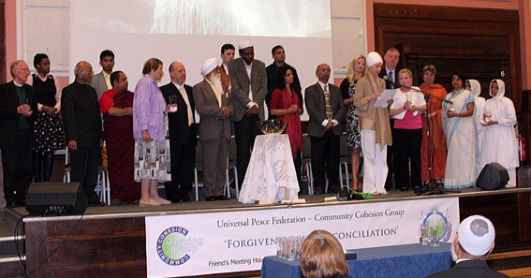
The Universal Peace Federation (UPF) – UK held a unique and special ‘Legacy of Peace’ event to commemorate and celebrate the life and work of notable Ambassadors for Peace within a one day conference examining ‘Forgiveness and Reconciliation’. In attendance in the Columbia Hotel, Lancaster Gate, London were people from all faith backgrounds and leaders and pioneers in interfaith. That itself spoke for the idea that no one religion has a monopoly on God or goodness and that this event was truly a collective offering and one that undoubtedly brought joy to our Creator.
Those whose lives were honoured in a moving ceremony were leading “Ambassadors for Peace” who passed away in recent years including Sheikh Dr Zaki Badawi, Prof. Ninian Smart, Mr OP Sharma OBE, Prof Anthony Flew and Mr. Maurice Geoghegan and several prominent international figures who had been close friends of the UPF and Father and Mother Moon including Pres. Abdurrahman Wahid, a former president of Indonesia, Shaykh Hassan Cissé of Senegal and Dr. Laxmi Mall Singhvi. Mr. Hédi Annabi, a Tunisian diplomat and head of the UN Stabilization Mission in Haiti, who died in the 2010 Haitian earthquake and the one hundred UN workers who died alongside Mr. Annabi were also remembered.
Spending time in the forest cleanses the mind. The sound of leaves rustling in the wind, the sound of the wind blowing through the reeds, the sound of frogs croaking in the ponds: All you can hear are the sounds of nature; no extraneous thoughts enter the mind. If you empty your mind and receive nature into your entire being, there is no separation between you and nature. Nature comes into you, and you become completely one with nature. In the moment that the boundary between you and nature disappears, you feel a profound sense of joy.
Then nature becomes you, and you become nature. I have always treasured such experiences in my life. Even now, I close my eyes and enter a state in which I am one with nature. Some refer to this as anātman, or “not-self,” but to me it is more than that, because nature enters and settles into the place that has been made empty. While in that state, I listen to the sounds that nature hands to me—the sounds of the pine trees, the sounds of the bugs—and we become friends. I could go to a village and know, without meeting anyone, the disposition of the minds of the people living there. I would go into the meadow of the village and spend the night there, then listen to what the crops in the fields would tell me. I could see whether the crops were sad or happy and that would tell me the kind of people who lived there.
Even the smallest grain of sand contains the principles of the world, and even a speck of dust floating in the air contains the harmony of the universe. Everything around us was given birth through a combination of forces so complex we cannot even imagine it. These forces are closely related to each other. Nothing in the universe was conceived outside the heart of God. The movement of just one leaf holds within it the breathing of the universe. From childhood, I have had a gift of being able to resonate with the sounds of nature as I roam around the hills and meadows. Nature creates a single harmony and produces a sound that is magnificent and beautiful. No one tries to show off and no one is ignored; there is just a supreme harmony. Whenever I found myself in difficulty, nature comforted me; whenever I collapsed in despair, it raised me back up.
‘What does it feel like to be a migrant or growing up in a migrant family? The impact of migration on families was the theme for the United Nations International Day of Families 2010 that was commemorated around the world by many chapters of the Universal Peace Federation. In Bromley, near London, several people who either were migrants or who are from migrant families, spoke on fairly similar themes about their experiences.’
‘I hate to see wasted talent.’ Was the first comment of Sheridan Mangal. He went to explain that he mentors 6 young boys from disadvantaged backgrounds from ethnic minorities in the UK. His motivation for this came from his father and mother who came from the Caribbean to the UK in the early 1950’s. They came for the economic opportunity with the attitude that the UK as the motherland was doing them a favour. It was a difficult course for them as a couple and later us as a whole family because they were people with talent and willing to work hard. Soon they were faced with resentment and bitterness from the indigenous workers as they were given greater responsibilities.
His house was always crowded with family members who followed them to the UK. His parents helped many close relatives to establish themselves in the UK. This led to some tensions as some paid rent regularly but others did not. His parent’s attitude was to keep their heads down and work hard. They encouraged him to do the same and try to get a Government job. However, he grew up here mixing with British children who were encouraged to reach for the stars. He did not understand why he should keep his head down and did not feel that the UK was doing him a favour. He saw that his parents had made an immense contribution through taxes and later by employing others.
Rohema Miah was one of six children who grew up in the UK. Their father is from Bangladesh and their mother is Welsh. Their father did not return to Bangladesh for 42 years but sent money back to support the family. The main route for Bangladeshis in the UK is through restaurant ownership. This has contributed £1.2bn per year to the British economy.
She added that their parents never imposed a religion on them. They were allowed to make their own choice and despite making different choices they have remained close as brothers and sisters.
On the occasion of Africa Day, May 25th, 2010, the Universal Peace Federation (UPF) extends its congratulations and best wishes to the African Union and all its member states, and the 900 million people of Africa. As well as celebration, Africa Day is an opportunity to reflect on the challenges and opportunities facing Africa and the world as we move into the second decade of this new millennium.
UPF is working through its chapters worldwide to promote dialogue and cooperation among religions, including the creation of an interreligious council at the United Nations; strengthen marriage and family, essential to end the scourges of poverty and AIDS; and promote service and good-will projects in and between nations to establish a culture of peace.
The UPF is committed to promoting peace and human development in all parts of the world. We are proud of our chapters throughout Africa — from the West to the East, from the North to the South — brothers and sisters who are working to build a world of lasting peace and help achieve the MDGs. We applaud the African Union for focusing on “peace and security in Africa” and we look forward to exploring the ways in which we can support its work, along with the United Nations, toward a world of peace and prosperity for all.
Africa Day 2010 will focus on “Peace and Security in Africa”. This year, the New York celebration will be a culinary and cultural exhibition of the rich diversity of the African continent. It will also mark the launching of a number of water treatment projects for Africa. The Universal Peace Federation (UPF) is being called upon by the African Union to assist in co-hosting the celebration in partnership with the United Nations African Ambassador’s Spouses Group (UNAASG).
An event focussing on Families and Migration gathered about 35 people at the Quaker Centre, Milton Keynes, on 15 May, observing UN International Day of Families 2010, at the invitation of Christa Rennie of the WFWP (Women’s Federation for World Peace) and her husband David, of the Universal Peace Federation. Navrita Atwal from the MK Equality Council spoke on “Family Values from an Asian Perspective”, Ayser Ali on “The Journey of a Family from Iraq to the West”, I (Sr Kate) on my experience with refugee and immigrant families in London, Milton Keynes and Yarls Wood Immigration Removal Centre, and David on the “Vision of the Universal Peace Federation”.
Between us, we made the following points: Migrating can be a huge gift, promoting openness to other cultures and the enrichment of learning other languages. “Home is wherever the family is”. However, moving can also be de-stabilising, and come at a bad age such as adolescence, when friends are all-important. Despite lessons in their mother language and the support of their ethnic or religious community, it happens sometimes that youngsters grow up feeling neither totally integrated in the new country nor accepted in their country of origin if they return there. The importance of family meals was stressed: parents – particularly from cultures where eating together is taken for granted and seen as a significant family value encouraging respect and caring – have difficulty sometimes in gathering the children when there is competition from other activities. Keeping in touch physically can be problematic as the family members grow up and move away: “Why should I need to make the journey back to visit when we can speak on the phone and even see each other with the web-cam?” If the migrant parents cannot learn English as fast as their offspring certainly will do, there is the risk of a widening rift in understanding in the family.
‘Globalisation has impoverished resource-rich developing African nations’ was a recurring theme last night during an early Africa Day 2010 event to coincide with the UK election campaign. Alice Ukoko, founder of Women of Afrika, Ruth Tanner, Campaign and Policy Officer of War on Want and Ahmed Shebani, Al Jamar Government and Media Centre Official Spokesperson, based in Tripoli, Libya were the main speakers. ‘All the UK political parties may guarantee at least 0.007% (of gross national income) in overseas development aid by 2011 but five times that amount is lost to developing countries in Africa through the tax dodging and capital flight of multi-national companies, including a number established in the City of London’ said Ruth Tanner.
Ahmed Shebani described Libyan charities that channeled funds into projects throughout Africa, the Libyan African Investment Portfolio (LAIP), the Wa Attassimou Foundation, promoted by HE Dr Ayesha Gaddafi, the daughter of Colonel Gadaffi and the Gaddafi International Charity and Development Foundation run by HE Saif al-Islam al-Gaddafi, which includes several leading UPF Ambassadors for Peace among it’s Trustees. These ventures are supporting both humanitarian projects and economic development. He mentioned that Libyans are also encouraged to emigrate to other African nations in order to establish businesses. Those with a good business plan receive a line of credit easily.
Alice Ukoko emphaised that African women could be a force for peace and development. She passionately stated that, ‘Imperial, colonial powers have burdened Africa and prevented development.’ The international aid should be stopped and Africa will be able to stand on its own two feet.
Aliu Bello: ‘I worked in UNICEF for 25 years. I know what aid does and doesn’t do. Even from the aid given to some African countries 80% is coming back here. It is not helping anybody in Africa. We could solve this if 70 – 80% of any aid is distributed through civil society. They are better organised and prepared to distribute resources where they are needed. We don’t need hand outs. Otherwise aid that doesn’t have this (stipulation) should be rejected. It should not be sent through the very governments that are ruining their economies.’
Kathmandu, Nepal – A new book written by Dr. Robert S. Kittel entitled ‘Two Paths to Peace’ was presented to the Hon. Nilamber Acharya, Chairman of the Constitutional Committee of the Constituent Assembly on April 12, 2010. A total of 70 books were given to the committee at a program organized at the Parliament Secretariat. The book offers valuable insights, principles, and experiences to the constitutional committee members. The book also offers insights into UPF Founders, Dr. and Mrs. Sun Myung Moon, and documents the contributions of their visits to Nepal and the initiatives they inspired to the peace process in Nepal from 2005 to 2009. This book is a case study highlighting the role which the Universal Peace Federation (UPF) has played, and continues to play, in helping peace return to the Land of Buddha.
UPF’s Role: Peacemaker, Peacebuilder Traditionally, the term “peace education” includes three categories: peacekeeping, peacemaking, and peacebuilding. Peacekeeping can be defined as violence management. Its goal is to respond to situations where violence has already broken out and prevent it from escalating further. Here, the people and Government of Nepal, UNMIN, and other international governmental and non-governmental organizations are the main players. They are the ones moving, coaching and guiding the peace process. UPF applauds and encourages their work. To support this, UPF has been making significant contributions in the areas of peacemaking and peacebuilding.
Bethlehem Baby Hospital, or Children’s Relief Bethlehem has long been a favourite place for the Universal Peace Federation’s Middle East Peace Initiative to visit. On Thursday April 15th there was an appeal made by Daniel Hurter of Children’s Relief Bethlehem UK during the Joint Faith’s Celebration.
A heartwarming 7 minute documentary of the work of Children’s Relief Bethlehem which finances and manages the Caritas Children’s Hospital. They provide medical care medical care for all children regardless of race, religion or ability to pay, together with health education and other projects to benefit families in this troubled region of the Occupied Palestinian Territories.
The Joint Faith’s Celebration was a accumulation of sharing, talk, reading, food, music and drama highlighting the significance of ‘Mawlid An-Nabi (Birth of Prophet Mohammed), Pesach (Passover), Easter And Vaisakhi’. Around the sharing of these precious faiths’ holy events there were many significant meetings among the 80 plus people gathered, including interfaith figures such as Rev. Dr Marcus Braybrooke, President of the World Congress of Faiths, Community Cohesion figures such as Dr Husna Ahmad, CEO, Faith Regen Foundation, Marilyn Brummer of the League of Jewish Women and humanitarian influential figures such as Dr Saif Ahmad, (MADE in Europe), Dr Hojjat Ramzy, Proprietor of the Iqra Girls’ School in Oxford and a presentation by Daniel Hurter about Children’s Relief Bethlehem.
Rev Dr Marcus Braybrooke explained the significance of Easter to Christians. ‘Lord Jesus Christ’s first word after resurrection was ‘Mary’. It was a personal word illustrating that this is a personal experience. Through the death of Jesus on the Cross we gained ‘Atonement’ for our sins. We can become ‘At One with God’. He described the feeling, ‘I am loved and forgiven’ rather than feeling abandoned by God. The belief in Easter is fundamental to Christians that illustrates that ‘love is stronger than hatred’.
Dr Husna Ahmad, CEO, Faith Regen Foundation identified a number of moral standards that were established by the Prophet Mohammed, (PBUH). Monetary honesty in financial dealings, keeping of one’s word and not lying were some of those standards that were established at that time that are needed during these days as well. The first human rights party was supported by Prophet Mohemmed who emphasised that wars had to fought ethically and respect given to prisoners of war in a code that had a role like the Geneva Convention today.
Jack Lynes showing his Freedom Pass explained that this (free London transport for those over 60 years old) has some parallels with Passover (Pesach)! He described the symbols of the Passover seder meal as a process of ‘visual early education’ rooted in the experience of the slaves in Egypt. The traditions of the ‘spring clean’ of the Jewish home before Passover as a healthy tradition that is supposedly looking for bread to remove from the house. The extra cup set out for Elijah to take on his return pressaging the coming of the Messiah. However, the belief of the children in Elijah’s coming has similarities to the belief in Father Christmas of Christian young children. Seder traditional ending is the toast, ‘next year in Jerusalem’. which has many meanings but Jack considers to be reliving the experience of those slaves, ‘next year we shall be truly free’.
Mr Sukhbir Singh explained, ‘Sikhs all over the world celebrated Vaisakhi yesterday, and will continue to do so for another few days. Vaisakhi for the Sikhs represents the birth of the Khalsa, and has its beginnings in a remarkable event that took place over 300 years ago. During the latter part of the 17th century, India was ruled by the Mogul Emperor Aurangzeb who was bent upon converting the Hindus into Islam.’ For more click here
Sukhbir Singh, Angad Kaur and Amarjeet-singh Bhamra
Vaisakhi of 1699
Ladies and Gentlemen, it is a pleasure being with you on the occasion of the Joint Celebtrations. I thank Margaret Ali and Robin Marsh for inviting me to share with you the Sikh celebration of Vaisakhi. Sikhs all over the world celebrated Vaisakhi yesterday, and will continue to do so for another few days.
Vaisakhi for the Sikhs represents the birth of the Khalsa, and has its beginnings in a remarkable event that took place over 300 years ago. During the latter part of the 17th century, India was ruled by the Mogul Emperor Aurangzeb who was bent upon converting the Hindus into Islam.
In 1675, Guru Tegh Bahadur, the ninth Guru of the Sikhs, gave the supreme sacrifice, to save Hindu religion from the hands of the Emperor, and was beheaded in Chandni Chowk Delhi. At this time, the only son of Guru Teg Bahadur, Guru Gobind Rai was only 9 years old when He resumed the Guruship as 10th Guru of the Sikhs.
From the very young age, Guru Gobind Rai was a perfect leader & motivator for the Sikhs. He organised Sikhs and led them to follow spiritual route to attain union with God and at the same time, trained them to be self-defendant and guard the helpless against injustice & tyranny. He re-iterated the “Saint-Soldier” concept. At the age of 33 i.e. 24 years since the Guruship, Guru Gobind Rai was set out to accomplish God’s spiritual mission started by Guru Nanak Dev Ji of creating “Khalsa Panth” (God’s Religion). He chose the day of Vaisakhi for such a grand venture. Before the event, Guru Ji has been quoted to have not made any public appearance for over 11 months.
The Vaisakhi Day
In early 1699, few months before the Vaisakhi Day, Guru Gobind Rai sent a special invitation to the Sikhs all over the country to join the special Vaisakhi Celebrations in the town of Anandpur Sahib in the Punjab state of India. He asked them not to cut any of their hair and to come with their turbans on. Masses of people turned up on the day.
About Eighty thousand Sikhs had gathered at this event. The Guru welcomed everyone and reminded them of their duty, commitment, loyalty and faith. Then to everyone’s surprise, The Guru withdrew his long sword and said in a very powerful voice “Who will be brave enough to come forward to offer me a head? The Guru asked for the sacrifice of head for the sake of Dharam, or religion. No one expected this to happen. This amazed and horrified many. There was a pin drop silence. Some people were looking for the way to escape. No one came forward. The Guru repeated this three times.
Based on the success and popularity of our past events particularly of the three faiths Joint Celebrations in April, 2009 (see last year’s joint celebration), the UPF Community Cohesion & Interfaith Working Committees would like to invite you to a Joint Celebration of the Holy Events of four faiths on Thursday April 15th, at 6.15pm at 43 Lancaster Gate, London, W2 3NA.
The Holy Days to be celebrated are:
MAWLID AN-NABI – The birth of the Prophet Mohammed, by Dr Husna Ahmad, CEO, Faith Regen Foundation.
PESACH – The season of Passover when Jews commemorate the liberation of the Children of Israel who were led out of Egypt by Moses. Jack Lynes will speak on ‘Freedom – The Passover Plate’.
EASTER commemorates the crucifixion and resurrection of Jesus Christ. Rev Dr Marcus Braybrooke, President of the World Congress of Faiths, will be speaking about Easter.
VAISAKHI – commemorates the establishment of the Khalsa at Anandpur Sahib in 1699 and the beginning of the Sikh New Year. Shukhbir Singh of Guru Nanak Nishkam Sewak Jatha–Birmingham will be explaining the significance of Vaisakhi to the Sikh faith.
As you well know these three Holy Days have a deep significance in the lives of the respective faith traditions and many who are less religious also hold these days as a special time in their yearly calendar – a time of togetherness in their families. As the 4 Holy Days are in close proximity, we are fortunate to have this opportunity to be together, to celebrate them all.


 The two slogans of the Universal Peace Federation (UPF) are ‘Living for the Sake of Others’ and humanity is ‘One Family Under God’.


 PeaceDevelopmentNetwork's Weblog