Posted by peacedevelopmentnetwork on June 9, 2020

International Media Association for Peace (IMAP).
“Assessing the Role of News Media in the Global COVID-19 Crisis”
Tuesday, June 9, 2020 at 17:00 BST
Panel:
Mrs. Cheryl Wetzstein, Senior Advisor, International Media Association for Peace (IMAP); former Senior Editor, The Washington Times, USA
Mr. Humphrey Hawksley Author, former BBC correspondent and Asia Bureau Chief, United Kingdom
Mrs. Lyudmila Fomicheva, President, Interfax-North-West; Chairperson, Union of Journalists of St. Petersburg and the Leningrad Region, Russian Federation
Mr. Willy Fautre, Director, Editor in Chief, Human Rights Without Frontiers (HRWF), Belgium
Dr. Rubina Möhring, President, Reporters Without Borders, Austria
After the presentations, there will be time for Q&A. Questions may be sent to peacetalks
Backgrounder:
Every nation faces continued lockdowns due to the COVID-19 pandemic, and massive health challenges and economic systems have stalled or teeter on the edge of a major collapse. During this civilization-level crisis, the media has played a vital role as a source of reliable information for billions of citizens. Information shared by mainstream and social media has been of paramount importance, not only for medical professionals but also for governments, our business environment, essential institutions and thousands of NGOs, which provide infrastructures to save lives of affected people.
At the same time, the media has come under severe criticism for allegedly exaggerating the size, impact, morbidity and mortality of the pandemic, thus inducing irrational fears and panic among many people. Furthermore, numerous journalists and media outlets have faced accusations for not sufficiently questioning government interests and even propagating conspiracy theories.
On a global scale, we are witnessing a fierce information war and battle of narratives concerning the origin of this new strain of coronavirus, the supposed cover-up in Wuhan by the Chinese communist regime and the belated reaction of the World Health Organization (WHO).
The International Media Association for Peace (IMAP), a new global project of UPF, provides an audience platform for media thought leaders to reflect on the challenges faced, lessons learned and recommendations for change to navigate the pandemic-tempered world.
Link to register at the Webinar: https://zoom.us/webinar/register/WN_SgLw_eFQQayF3dKUS4dr3A/
If you have any questions or problems connecting please contact me on the details below. This is organised by Europe and Middle East – Universal Peace Federation.
Robin Marsh
Secretary General
Universal Peace Federation (UPF) – UK
UPF UK is now a Charity Number 1185412
Please donate to support our work here
Mobile: 07956210768
pa
@ukUPF
www.uk.upf.org
UPF is an NGO in General Consultative Status with the Economic and Social Council of the UN

Posted in Peace and Development | Leave a Comment »
Posted by peacedevelopmentnetwork on May 31, 2019
Dear Friends,
UPF is partnering with ShoutOutUK to help young people break down the barriers between politicians and the electorate, we would very much like you, being young or old, to come and support this event. Here is more about it, please respond to the link below to show your interest.
Join us for the UK’s FIRST EVER Youth Political Sports Festival!
The festival will run a series of sporting events which pits political figures against each other to break down the barrier between politicians and the electorate. Inspired by the BBC show superstars, MPs will compete against each other in a decathlon-style sports competition. Earning points for each sport they compete in, with the final winner being able to give a speech to the end!
Politics is becoming increasingly tribal, with society becoming ever more polarised and divided. We wish to bring politics into amateur sport, with the aim of uniting people around a common passion, attracting people who may not otherwise be interested in politics and channelling the growing competitiveness surrounding politics and between political parties into something positive.
An idea of this kind has never been tried before in the UK. Be part of something NEW, join us this Summer!
https://www.eventbrite.co.uk/e/polifest-the-youth-political-sports-festival-tickets-62200658845
Agenda
09.00 – Registration
10.00 – Welcome speech + MC (Aaron Roach Bridgeman) introductions
10.10 – Pre-Event Survey + Online Menti-Meter Game run by MC
10.30 – Political Party Team Introductions with Music
11.00 – ROUND 1 Endurance – 100 METRE SPRINT
11.20 – ROUND 2 Mental Stamina – (questions submitted by the audience)
12.00 – Round 3 Team Work – RELAY RACE
12.30 – Awards Announced + winning speech
13.00 – Lunch, networking with MP’s
14.00 – Workshop Series + Reflections (choice of 4)
15.10 – Workshop Series + Reflections (choice of 4)
16.10 – Post-Event Survey
16.20 – Meet the Youth Party Wings + networking

If you wish to unsubscribe from emails from Universal Peace Federation, please reply with ‘Unsubscribe’ in the subject line.
Posted in Peace and Development | Leave a Comment »
Posted by peacedevelopmentnetwork on April 19, 2019
| Family Festival: Marriage Beyond Borders |
|
 |
|


Universal Peace Federation – UK
Family Federation for World Peace-UK
Women’s Federation for World Peace
Saturday, 1.30 pm May 11th, 2019
At 43 Lancaster Gate, London, W2 3NA
Family Festival: Marriage Beyond Borders
Dear Friends and Ambassadors for Peace,
It is our great pleasure to invite you to attend our ‘Family Festival: Marriage Beyond Borders’. While last time we highlighted the stories that each family has to tell, on this occasion we will be focussing on the capacity of couples to overcome language, culture, race, religion or even enemy nation status. Love, marriage and families have the ability to bring the world of humanity together and are a major inspiration for a peaceful world.
The FFWPU (Family Federation), WFWP (Women’s Federation for World Peace) and UPF (Universal Peace Federation) with its founders, Father and Mother Moon, promote marriage as a sacred institution that can create healthy and loving families. Those families can provide the experience of living for the sake of others, learning to love different types of characters and the art of compromise and negotiation. It is natural for such loving families to develop caring relationships among their extended network of relatives, which become a component of stable communities and nations.
At the Festival we will have a light hearted look at the great institution of marriage and hear some uplifting stories of those who overcame great difficulties to nurture vibrant and growing families.
This will lead up to a Rededication of Marriage Blessing Ceremony for some couples who have been preparing for this day. A series of faith’s readings will be included for inspiration. To understand the significance of this Marriage Blessing please see this presentation.
There will be musical contributions during the programme featuring Betty Rodrigues and Patti Boulaye (TBC) and others.
People will gather from 1.30 pm for refreshments and registration on Saturday 11th May at 43 Lancaster Gate, London W2 3NA. The nearest station (7 minute walk) is Lancaster Gate on the Central Line. The programme will start at 2 pm. We intend to finish by 4 pm for refreshments and fellowship. There will be a children’s room with many activities as well.
Please come along with your children and enjoy the afternoon with us.
Looking forward to hearing from you.
Warm regards,
Matthew Huish: National Director FFWPU – UK
Ajay Rai: Central London Community FFWPU
Francis Fobbie: Pastor East London FFWPU
Jeff Bateman: Pastor of North London FFWPU
Mitty Tohma: President of WFWP – UK
Robin Marsh: UK – UPF Secretary General
Ron Chandler: Pastor of Bromley FFWPU

Share this event on Facebook and Twitter. |
|
|
 |
|
|
|
 |
This invitation was sent to pa by the organiser of this event, UK – Universal Peace Federation .
To stop receiving invitations from this organiser, you can unsubscribe.Eventbrite UK Ltd | 10-11 Charterhouse Square | EC1M 6EE London |
|

Posted in Peace and Development | Leave a Comment »
Posted by peacedevelopmentnetwork on April 18, 2019
| Bringing Change to Our Communities
Saturday 27th April 2019 |
|
|
|
| Are you a person who works with young people or a young person yourself? are you generally interesting in the future of our young people?
If so be sure to come and bring the interested people with you to the UPF Young Achievers event run by ShoutOut UK and UPF.
Time/Date: Refreshments from 10:30am , Saturday 27th April 2019
Location:
43 Lancaster Gate
London
W2 3NA
Topics discussed:
Are you tired of seeing homeless people in our streets and feeling hopeless about how to help them?
I know we are all surprised and hearing yet another knife and gun crime in our borough in our street or somewhere in the UK do you think its time that we all did our bit to help this enormous problem. Please come and hear pertinent stories regarding knife and gun crime.
You will have the opportunity to join a ‘Hackathon’ to share your ideas, interact with others and inspire change for the future of our youth. |
|
|
|
| Help Prevent Avoidable Deaths Lost By Suicide
7th May 2019 in House of Commons |
| When you feel suicidal in the UK, doctors tell you to go to A&E. What you will find there is based on luck: will you find compassion? Or will you be judged and turned away? A majority of the time, the latter. Yet, asking for help can be a turning point for individuals in crisis. |

|
| We are a team of people profoundly touched by lives both lost and saved by suicide who want to change this current reality. So we have launched a petition to call on parliament to create a nation-wide, guaranteed response to individuals seeking help for suicidal thoughts and feelings in our hospitals!
Link to Petition
About the Event
For the last 5 months we have been running a campaign to raise awareness about the dangerous inconsistency in the response of hospitals across the country towards individuals in crisis.
Two of our group ran across the width of the UK to raise signatures and awareness, leading to two BBC interviews and a whole heap of additional signatures.
Now that we are coming to the time limit of our petition, we are running a final push to get the 10,000 signatures needed to get a response from Government.
Who Is This Event For?
We are all touched by mental health issues in some way in our lives. Whether it’s us, our co-workers, our family, our friends, the musicians we listen to, the nurses and doctors who help us or the politicians who make the decisions.
Mental illness and suicidal thoughts don’t discriminate.
If you are interested in improving mental health support in the UK and would like to show your support for this petition and the changes we are calling on the government to implement, this event is for you.
Your support and participation will make a big difference.
Agenda:
6pm: Arrival
6:15pm prompt: An introduction and viewing of the campaign film
6:20pm: Interviews with Michelle and Johnny who ran the width of the UK
6:50pm: Panel with MPs followed by Q&A |
 |
|
|
|
| If you wish to unsubscribe from receiving emails from us please reply with ‘Unsubscribe’ in the subject line. |
|
|
|
|
|
Posted in Peace and Development | Leave a Comment »
Posted by peacedevelopmentnetwork on November 27, 2015

Universal Peace Federation (UPF)
Universal Peace Federation Peace Council
43 Lancaster Gate, W2 3NA
10.30 am Saturday 5th December 2015
We would like to invite you to the annual year end gathering as a follow up and a preparation for next year. One of the central themes of the development of the Universal Peace Federation (UPF) is the Peace Council that was proposed at the founding of the UPF as a place for people from many backgrounds to join together to discuss goals and strategies that can influence a nation or a city in a good direction. It was proposed as a forum for the exchange of ideas and experiences.
The Peace Council was proposed as the forum to bring together national level people of many backgrounds in order to pool their efforts. UPF in the UK is known for holding events and activities such as commemorating special UN Days such as World Interfaith Harmony Week, UN Day of the Girl, International Women’s Day, World Interfaith Harmony Week, Prevention of Sexual Violence in Conflict, Youth Engagement in Politics, as well as Sustainable Development Goals and Climate Change conferences. We are also known for human rights events, interfaith activities, promotion of the family and the development of Youth UPF. We are a partner of Parliament Week and Youth UPF held a workshop on youth political understanding during Parliament Week 2015. We have held a series of events to raise awareness of human rights issues of sexual violence in eastern DR Congo and Conflict Minerals.
During this Peace Council 2015 we will have contributions from some of the Directors of UPF. They will explain a three year activity and fundraising plan for 2016 – 2018. We have a plan to focus on inter-religious programmes, Importance of the Family and how help strengthen the Family, finally on Peace building, centred on Inter Religious, Inter Racial and Inter Communal, Cooperation as well as Peace Activities.
There will be contributions from several Ambassadors for Peace. These will include Cecilia Hallstrom from Malmo Central Mosque in Sweden and Saoussen Ben Cheikh who will explain her work on the Turkish border with Syria with refugees from the Syrian conflict. She has been working with Medicin Sans Frontiere for several years and now working with another charity. There will be a few reports / models of good practice including Birmingham and South London.
During our Peace Council on December 5th 2015 you will be joining Ambassadors for Peace, UPF members and activists from different parts of the UK. There will be a number of notable speakers present on the day who have been part of our regular activities throughout the year.
If you have not renewed your UPF Membership, it is only £30. If you join before the Peace Council (or at the reception desk on the day), where entrance to the Peace Council will be £5 instead of £12 to cover lunch costs. Tickets can be bought online in advance to reserve your place through this link. Otherwise it will cost £12 to attend the Peace Council. Please let us know any dietary requirements.
Yours sincerely,
Secretary General – Robin Marsh (07956210768)
Director – Margaret Ali (07723024750)
Director – Joyce Suda (07903311052)
Universal Peace Federation (UPF) – UK
Office: 02072620985
www.uk.upf.org @ukUPF pa@uk.upf.org
UPF is an NGO in Special Consultative Status with the Economic and Social Council of the United Nations
Please like our Facebook Page
YouTube Channel
Unsubscribe
Posted in Peace and Development | Leave a Comment »
Posted by peacedevelopmentnetwork on November 26, 2015

Universal Peace Federation (UPF)
UPF Peace Council
43 Lancaster Gate, W2 3NA
10.30 am Sat 5th December 2015
We would like to invite you to the annual year end gathering as a follow up and a preparation for next year. One of the central themes of the development of the Universal Peace Federation (UPF) is the Peace Council that was proposed at the founding of the UPF as a place for people from many backgrounds to join together to discuss goals and strategies that can influence a nation or a city in a good direction. It was proposed as a forum for the exchange of ideas and experiences.
The Peace Council was proposed as the forum to bring together national level people of many backgrounds in order to pool their efforts. UPF in the UK is known for holding events and activities such as commemorating special UN Days such as World Interfaith Harmony Week, UN Day of the Girl, International Women’s Day, World Interfaith Harmony Week, as well as Sustainable Development Goals and Climate Change conferences. We are also known for human rights events, interfaith activities, promotion of the family and the development of Youth UPF. We are a partner of Parliament Week and Youth UPF held a workshop on youth political understanding during Parliament Week 2015. We have held a series of events to raise awareness of human rights issues of sexual violence in eastern DR Congo and Conflict Minerals.
During this Peace Council 2015 we will have contributions from some of the Directors of UPF. They will explain a three year activity plan for 2016 – 2018. We have a plan to focus on inter-religious programmes, importance of the family and how to strengthen the family, finally on peace building, centred on inter-religious, inter-racial and inter-community cooperation as well as other peace activities.
There will be contributions from several Ambassadors for Peace. These will include Cecilia Hallstrom from Malmo Central Mosque in Sweden and Saoussen Ben Cheikh who will explain her work on the Turkish border with Syria with refugees from the Syrian conflict. She has been working with Medecins Sans Frontieres for several years and now working with another local Turkish charity.
During our Peace Council on December 5th 2015 you will be joining Ambassadors for Peace, UPF members and activists from different parts of the UK. There will be a number of notable speakers present on the day who have been part of our regular activities throughout the year.
Annual Membership is only £30 if you join before the Peace Council (or at the reception desk on the day), where entrance to the Peace Council will be £5 instead of £12 to cover lunch costs. Otherwise it will cost £12 to attend the Peace Council.
Yours sincerely,
Secretary General – Robin Marsh (07956210768)
Director – Margaret Ali (07723024750)
Director – Joyce Suda (07903311052)
Universal Peace Federation (UPF) – UK
Office: 02072620985
www.uk.upf.org @ukUPF pa@uk.upf.org
UPF is an NGO in Special Consultative Status with the Economic and Social Council of the United Nations
Please like our Facebook Page
YouTube Channel
Unsubscribe
Posted in Peace and Development | Leave a Comment »
Posted by peacedevelopmentnetwork on November 9, 2015

Universal Peace Federation UK
Interfaith Week Event
43 Lancaster Gate, London, W2 3NA
6 pm 25th November, 2015
RSVP to pa
Baldev Singh-Bains, Sikh Consultative Council-UK
Sanjay Jagatia: Secretary General, Hindu Council-UK
Yeotunde Adeola, Women of Faith Foundation
Sheikh Hojjat Ramzy, Chairman of Education Committee, Muslim Council of Britain
Edwin Shuker, Vice President, European Jewish Congress
Samani Punya Pragya MA and Dr. Samani Unnat Pragya, Jain Nuns
Rev. Dr. Marcus Braybrooke, President, World Congress of Faiths (TBC)
Plus Diary Note for Annual Peace Council – December 5th see below
Dear Friends,
During Interfaith week we have a good opportunity to consider the state of inter-religious, intra-religious, and inter-community relations. In some cases it is the intra-religious tension that is the more difficult to overcome. As a group of people from different faith backgrounds, as well as no faith, we are attempting to create different models that enhance interaction between communities within the UK.
The UK is advanced in its efforts to bring communities together but it is also an effort that needs continual reinforcement and is subject to the influence of international tensions. These challenges oblige us to maintain our efforts. One significant influence is the Syrian crisis that calls us to reflect on our values and our responsibility to give sanctuary to refugees who have lost so much. Many religious leaders and founders have been refugees in times of great conflict when their guiding principles were tested by unpopularity and persecution. We would like to propose that young people also join the conversation and challenge themselves to develop their capacity to serve other communities and learn and understand the “OTHER” and to take the less popular route to learn essential points of faith, through the process.
At this time, on Wednesday 25th we would like to invite people of various faiths and cultural backgrounds and some young representatives and people working with young people, to consider how inter-religious harmony and cooperation can help us to understand and deal with the current problems facing our country.
We hope that this event will allow each speaker to explore different models of improving understanding and interaction between communities. Along the lines of the saying, ‘You cannot solve a problem on the same level of consciousness that it was created’ we also hope to hear innovative ideas utilising scriptural wisdom to tackle current problems.
Please also reserve the date December 5th in your diary for the pa or go this link for more information.
Yours sincerely,
Robin Marsh, UPF-UK Secretary General – Mobile: 07956210768
Margaret Ali, UPF-UK Director – Mobile: 07723024750
Joyce Suda, UPF-UK Director – Mobile: 07903311052
Office: 02072620985 Web: www.uk.upf.org
Email: pa Twitter: @ukUPF
UPF is an NGO in Special Consultative Status with the Economic and Social Council of the United Nations
If you want to Unsubscribe please write this in the title and reply to pa
Posted in Peace and Development | Leave a Comment »
Posted by peacedevelopmentnetwork on November 8, 2015

Universal Peace Federation UK
Interfaith Week Event
43 Lancaster Gate, London, W2 3NA
6 pm 25th November, 2015
Baldev Singh-Bains, Sikh Consultative Council-UK
Sanjay Jagatia: Secretary General, Hindu Council-UK
Yeotunde Adeola, Women of Faith Foundation
Sheikh Hojjat Ramzy, Chairman of Education Committee, Muslim Council of Britain
Edwin Shuker, Vice President of the European Jewish Congress
Rev. Dr. Marcus Braybrooke, President, World Congress of Faiths (TBC)
Dear Friends,
During Interfaith week we have a good opportunity to consider the state of inter-religious, intra-religious, and inter-community relations. In some cases it is the intra-religious tension that is the more difficult to overcome. As a group of people from different faith backgrounds, as well as no faith, we are attempting to create different models that enhance interaction between communities within the UK.
The UK is advanced in its efforts to bring communities together but it is also an effort that needs continual reinforcement and is subject to the influence of international tensions. These challenges oblige us to maintain our efforts. One significant influence is the Syrian crisis that calls us to reflect on our values and our responsibility to give sanctuary to refugees who have lost so much. Many religious leaders and founders have been refugees in times of great conflict when their guiding principles were tested by unpopularity and persecution. We would like to propose that young people also join the conversation and challenge themselves to develop their capacity to serve other communities and learn and understand the “OTHER” and to take the less popular route to learn essential points of faith, through the process.
At this time, on Wednesday 25th we would like to invite people of various faiths and cultural backgrounds and some young representatives and people working with young people, to consider how inter-religious harmony and cooperation can help us to understand and deal with the current problems facing our country.
We hope that this event will allow each speaker to explore different models of improving understanding and interaction between communities. Along the lines of the saying, ‘You cannot solve a problem on the same level of consciousness that it was created’ we also hope to hear innovative ideas utilising scriptural wisdom to tackle current problems.
Yours sincerely,
Robin Marsh, UPF-UK Secretary General – Mobile: 07956210768
Margaret Ali, UPF-UK Director – Mobile: 07723024750
Joyce Suda, UPF-UK Director – Mobile: 07903311052
Office: 02072620985 Web: www.uk.upf.org
Email: pa Twitter: @ukUPF
UPF is an NGO in Special Consultative Status with the Economic and Social Council of the United Nations
Posted in Peace and Development | Leave a Comment »
Posted by peacedevelopmentnetwork on June 17, 2015
Universal Peace Federation – UK Dinner

43 Lancaster Gate, London, W2 3NA
6.30 pm, Thursday, 2nd July, 2015
We would like to invite you to a Universal Peace Federation (UPF) Dinner on July 2nd at 43 Lancaster Gate, London, W2 3NA. Please join us to celebrate the work and the ideals of UPF. It is £30 for a ticket to join us for a wonderful evening with Great Music, featuring singer – songwriter, Tally Koren, and a young musicians group called “Music Loving Family”, amongst 
others. Sheikh Dr Hojjat Ramzy, a UPF Director, will be conducting an Auction extraordinaire with some wonderful items.
During the evening Keith Best, also a Director will be speaking about UPF’s ideals as well as his experience of 30 years of public service. Keith, a former MP, is the Chair of the Executive Committee of the World Federalist Movement from 1987. He has been the director of Prisoners Abroad between 1989-1993. In 1993, he became Chief Executive of the Immigration Advisory Service. In 2003, he was named among the most influential top one hundred people in public services in the UK. In the beginning of 2011 he became the CEO of Freedom from Torture.
We hope you can join us for a great evening to celebrate the values that bring us together to have an impact on this world.
Tickets can be obtained through this linkor by sending us a cheque payable to Universal Peace Federation, 43 Lancaster Gate, London, W2 3NA.
Yours sincerely,
Robin Marsh, UPF-UK Secretary General – Mobile: 07956210768
Margaret Ali, UPF-UK Director – Mobile: 07723024750
Joyce Suda, UPF-UK Director – Mobile: 07903311052

Office: 02072620985 Email: pa
Twitter: @ukUPF www.uk.upf.org
UPF is an NGO in Special Consultative Status with the Economic and Social Council of the United Nations
Unsubscribe
Posted in Peace and Development | Leave a Comment »
Posted by peacedevelopmentnetwork on June 10, 2015
Solicitors International Human Rights Group (SIHRG) & Universal Peace Federation (UPF) – UK
Eritrea: Business Ethics, Migration and Trafficking
Monday, 6pm, 15th June, 2015
43 Lancaster Gate, W2 3NA
You are cordially invited to Eritrea: Business Ethics, Migration and Trafficking. This is the third part series on Eritrea and the development of Business and Human Rights and Corporate Social Responsibility. This panel discussion will look at the key issues facing Eritrea from the development of its natural resources through to migration and trafficking.
Introduction & Welcome: Robin Marsh, Sec. Gen. UK-UPF Chair: Ruby Sandhu, Vice Chair of SIHRG
Mr Todd Romaine, VP Corporate Social Responsibility, Nevsun Resources Limited. Todd will discuss business operations in Eritrea and the recent CSR Report and the company’s vision to generate shared prosperity through its business operations. This objective means much more than just generating economic benefit. It also means protecting the safety and health of employees, mitigating environmental impacts from its activities, respecting the human rights of its workers and the residents of the communities in which it operates, and contributing to the sustainable development of those communities.
Lloyd Lipsett, LKL International. Lloyd is an international human rights lawyer with over 15 years of experience working with leading companies, governments, national human rights institutions, civil society organisations and indigenous peoples. He has developed a niche in the field of human rights impact assessment with a focus on extractive industry projects and free trade agreements. He has special expertise on indigenous peoples rights, economic, social and cultural rights and stakeholder engagement.
Indira Kartallozi, Chrysalis Family Futures. Indira is the founder and director of Chrysalis Family Futures – a social enterprise that stands for protection and empowering of human and socio-economic rights of vulnerable and marginalised families and children. Indira has 15-year experience and on issues of migration and human rights. Her work with Chrysalis Family Futures has taken her to various countries in Africa, Europe and Latin America.
Simon Tesfamariam, Trafficking in Eritrea. Simon is the founder and director of the Red Sea Institute, an Asmara-based think tank, whose mission is to advance sustainable peace, economic development, and social progress in the Red Sea Basin and Horn of Africa sub-region. He is an active blogger on Eritrean issues and has written extensively on human trafficking and migration. He received his B.S. in Biochemistry from the University of Washington and is currently a student at Duke University School of Medicine.
Closing Remarks: Robin Marsh
Venue: 43 Lancaster Gate, London W2 3NA Monday, 15 June 2015
6pm: Registration 6.30pm: Event starts
Register: pa
| Event to be Live Streamed on: |
|
|
Robin Marsh
Secretary General
Universal Peace Federation (UPF) – UK
Mobile: 07956210768
Office: 02072620985
www.uk.upf.org @ukUPF pa@uk.upf.org
UPF is an NGO in Special Consultative Status with the
Economic and Social Council of the United Nations
Facebook Page
YouTube Channel
Posted in Peace and Development | Leave a Comment »
Posted by peacedevelopmentnetwork on June 1, 2015

Universal Peace Federation – UK
Celebration of Africa Day 2015:
The Inspiring Things To Learn From, Or See Developing, In Africa
6.30 pm, 4th June 2015
43 Lancaster Gate, London, W2 3NA
Speakers Include:
Justina Mutale: African Role Model and Women of the Year 2012
Pauline Long: Founder BEFFTA Awards, Media Figure
Charlotte Simon: Founder Mothers of Congo
Rukayat Aderewa Basaru: True African Heritage Media
We are honoured to invite you to attend a celebration of Africa Day 2015. We are happy to share this day with our friends and partners in the event. There are more full biographies below. Africa Day is a wonderful opportunity to celebrate the achievements of a fast growing continent. There are many inspirational examples from nations like Botswana that is relatively free of corruption and has free education and health due to a growing economy based on diamonds. The family culture, (which really means the extended family) that is prevalent throughout Africa. The religious nature of African people. The music and foods of different parts of the African continent, which always creates a welcoming atmosphere. The world comes to Africa for minerals and other resources. There is so much more to Africa to learn from and gain inspiration.
UPF International celebrates Africa Day each year. Several times this has been in the Manhattan Centre in New York with the UN Secretary General, Ban, Ki-Moon. It reflects the partnership between the African Union and UPF. There will be African food, music, cultural wisdom, story-telling and clothes.
Please come and celebrate with us. Kindly RSVP to reserve your place.
Warm regards,
Robin Marsh: UPF-UK Secretary General Mobile: 07956210768
Margaret Ali: UPF-UK Director Mobile: 07723024750
Joyce Suda: UPF-UK Director Tel: 07903311052
Universal Peace Federation (UPF) – UK
Office: 02072620985
pa
UPF is an NGO in Special Consultative Status with the Economic and Social Council of the United Nations
Latest Newsletter
Please like our Facebook Page
YouTube Channel
Biographies of Speakers:
Justina Mutale:
Acclaimed as one of the most influential and inspirational women of African origin, Justina Mutale is the AFRICAN WOMAN OF THE YEAR 2012, an honour bestowed upon Justina on the same platform as Archbishop Desmond Tutu of South Africa as well as the former President of Malawi, The Rt. Hon. Joyce Banda and the former female Deputy Prime Minister of Zimbabwe, The Hon. Thokozani Khupe. Justina is also Honorary Ambassador for Gender Equality, a UPF Ambassador for Peace and a Spokesperson for the INTERNATIONAL WOMEN’S THINK TANK, which is headquartered in Atlanta, Georgia in the USA. Founder of POSITIVE RUNWAY, Global Catwalk to stop the spread of HIV, Justina has been featured as a Hero in the Capital Finance International Journal, which brings coverage and analysis of the drivers behind change by combining the views of leading multilateral and national organizations with thought leadership from some of the world’s top minds. Having gained global recognition for her ability, as a public personality to use her status to potentially influence the thinking of both Africans and non-Africans alike, Justina is featured among the 365 of Africa’s most respected names, well-known faces, and influential voices who inspire the future, motivate the young generation, and raise the profile to positively alter the perceptions of Africa and Africans around the world.
Pauline Long:
The Mother of two and entrepreneur was recently listed in the Black Women in Europe Power List as the most powerful and inspirational black women in Europe.
Pauline Long is the founder of Europe’s biggest award ceremony, the BEFFTA AWARDS, that celebrates and honours black and ethnic personalities in entertainment, film, fashion, television and arts. She is also the founder of Mr and Miss East Africa UK. She is a UPF Ambassador for Peace. As a passionate community personality and philanthropist, she mentors many youth in the industry and supports unsigned artists through her award-winning film studio, East End Studios. She hosts the Pauline Long show, a premier global TV talk show with a global audience broadcasting live from London on SKY 182-BEN TV, discussing current issues, politics, economy, beauty, fashion, entertainment, film, charity and more.
Charlotte Simon:
Charlotte Simon-Bongumba founded the Mothers of Congo to highlight both the horrors of mass rape and war crimes in the Eastern Democratic Republic of Congo (DRC). (www.mothersofcongo.org). She has called for the end to impunity for those who have committed rape or war crimes in the last 18 years in DRC. She has supported her daughter’s efforts to fund clinics in eastern DRC that deal with the victims of sexual violence. (www.tatianagiraudfoundation.org)
Mrs Simon-Bongumba was presented with Ambassador for Peace award, BEFFTA Award and the ‘African Achievers Award for Woman’s Empowerment’ for the ‘life changing work for the women of the Democratic Republic of Congo both home and abroad in an area as critical as sexual violence. As an individual and through the work of Mother of Congo your desire and practical commitment to transforming the destinies of women who have suffered horrific crimes has become a source of inspiration, hope and empower for many.’
Unsubscribe
Posted in Peace and Development | Leave a Comment »
Posted by peacedevelopmentnetwork on October 19, 2014
 The two slogans of the Universal Peace Federation (UPF) are ‘Living for the Sake of Others’ and humanity is ‘One Family Under God’.
The first slogan, ‘Living for the sake of others’ is used by UPF to resolve conflicts and encourage personal growth. This conference has considered national branding deeply. The ultimate branding should be respected and trusted as someone who has integrity, a company that is law abiding and is a valuable stakeholder in the community or nation or a nation that is respected for its contribution to solving the problems of other less fortunate nations or to resolving world problems. In the UK prior to the last election in 2010 I was very happy that all three political parties had committed themselves to achieving 07 of 1% of Gross National Income to dedicate to Overseas Development Aid. It was something that we and many other NGOs had campaigned for before the election and since there has been a constant battle to maintain that total and the altruistic sincerity of the purposes for which it was and is being used. Read the rest of this entry »
Posted in Peace and Development | Tagged: Development, faith, family, human rights, peace, Universal Peace Federation, UPF | Leave a Comment »
Posted by peacedevelopmentnetwork on October 13, 2014

Meeting in the House of Lords
Japanese Universal Peace Federation (UPF) delegation in House of Lords today – Dr Yong Cheon Song speech – UPF Japan looking for the wisdom of post-war Europe that enabled peace, integration of nations and freedom – bit.ly/1svsTmZ
Posted in Peace and Development | Tagged: Japan, United Kingdom, Universal Peace Federation, UPF | Leave a Comment »
Posted by peacedevelopmentnetwork on October 11, 2014
Event: Today’s Youth, Architects of Peace? London October 22 including #IamTawfik campaign. #libya @JohnLoughton RT http://t.co/UQMU0xXi3R
Posted in Peace and Development | Leave a Comment »
Posted by peacedevelopmentnetwork on October 6, 2014
http://ow.ly/Ckb6t Yvonne Chaka Chaka Receives Ambassador for Peace award during Africa Rising Power14 Programme in London #ukUPF
Posted in Peace and Development | Leave a Comment »
Posted by peacedevelopmentnetwork on September 30, 2014
 ‘Breaking the Slave Chain’ a Youth UPF and ABSoc event in SOAS (School of Oriental and African Studies) University of London last night. Humphrey Hawksley (BBC World Affairs Correspondent), Hannah Bruce (Ethical Trading Initiative), Colleen Theron (Stop the Traffik) and Chaired by Ollie Davies (Youth UPF Director). http://ow.ly/i/73zL9 http://bit.ly/1xwPN0f
Posted in Peace and Development | Leave a Comment »
Posted by peacedevelopmentnetwork on September 29, 2014
New Global Witness research shows EU must do more to reduce deadly #conflictminerals trade: http://t.co/aJeA9LM7N9 EU trade in tin, tantalum, tungsten and gold (‘conflict minerals’ when sourced from DRCongo for example) was responsible for almost a quarter (€28.5 billion) of the global trade in tin, tantalum, tungsten and gold ores and metals, which was worth over €123 billion.
Posted in Peace and Development | Leave a Comment »
Posted by peacedevelopmentnetwork on September 26, 2014
Dr B K Modi, Founder Global Citizen Forum, photo with Dr.Thomas G. Walsh, Universal Peace Federation President, Larry Beasley CEO & Pres & Thomas P.McDevitt Chairman of the Washington Times http://t.co/UwP8ibIciA

More About:
Dr B K Modi Founder of Global Citizen Forum: http://lp.yuucore.net/gcf/founder.html
Dr Thomas Walsh UPF President http://www.upf.org
Posted in Peace and Development | Tagged: Development, globalcitizens, Interfaith, peace | Leave a Comment »
Posted by peacedevelopmentnetwork on September 26, 2014
Africa Rising conf The Role of the Diaspora African Woman bit.ly/1urj3nR #UPF inc. South African Singer, YVONNE CHAKA CHAKA #POWER14
Posted in Peace and Development | Leave a Comment »
Posted by peacedevelopmentnetwork on September 24, 2014
Press Release (for immediate release)
 YVONNE CHAKA CHAKA TO SPEAK AT AFRICA RISING CONFERENCE IN LONDON
South African Superstar and Legendary Singer, YVONNE CHAKA CHAKA will be in London next week. Ms Chaka Chaka, who is a UNICEF & Roll Back Malaria Goodwill Ambassador and Founder of Princess of Africa Foundation will hold the London premiere of her film: “A MOTHERLAND TOUR: A Journey of African Women with Yvonne Chaka Chaka” which will be screened in the wings of the 58th BFI London Film Festival.
Ms Chaka Chaka will also be a Keynote Speaker at the Conference on “AFRICA RISING: THE ROLE OF THE DIAPSORA AFRICAN WOMAN”, which will be hosted by the Rt. Hon. Baroness Verma, Under Secretary of State for Energy and Climate Change at the House of Lords, Westminster Houses of Parliament on Thursday 2nd October 2014. The Women’s Conference will discuss the role of women in the rise of Africa, with special focus on the need for the Diaspora African Woman to constructively engage with the current exciting and transformative moment in Africa’s history. The Conference aims to provide delegates an opportunity to gain insight and join discussions about the realities, obligations, obstacles and opportunities for the Diaspora African Woman in Africa Rising. The Conference has been convened by members of the “POWER 14″, who include Justina Mutale, Founder & CEO of POSITIVE RUNWAY, who is also African Woman of the Year 2012 and Gender Equality Ambassador & Spokesperson for the International Women’s Think Tank; Jacqueline Onalo, Human Rights and Immigration Lawyer at R. Spio & Company Solicitors and a trustee of Community Development Initiatives (CDI); and Deborah Owhin, Gender Equality Specialist and Founder of Made Equal, a vision to engage, educate and empower people in their 20s and 30s in the campaign to eradicate gender inequality.
“It is hoped that this Conference can provide an avenue for understanding and paving a way for African women, including those in the Diaspora, to play an integral part in the rise of the continent in the wake of Africa’s changing political, environmental; economic and social landscape; as well as in the United Nations Post-2015 Sustainable Development Agenda” says Justina Mutale. Read the rest of this entry »
Posted in Peace and Development | Tagged: Africa, Ambassadors for Peace, Development, Diaspora, Health, MDGs, SDGs, women's rights | Leave a Comment »
Posted by peacedevelopmentnetwork on September 21, 2014
World is getting less peaceful. It is official! The Global Peace Index research into costs and benefits of peace is very thorough. The eight pillars of peace for stable and resilient nations are very important to maintain. #peaceday #jcipeace14 Camilla Schippa http://bit.ly/1ubOgvo
Posted in Peace and Development | Tagged: Civil Society, human rights, Millennium Development Goals, peace, Peace Movement | Comments Off on World is getting less peaceful. It is official!
Posted by peacedevelopmentnetwork on September 17, 2014
#UN #FAO More than 800 million people – or 1 in 9 in world – suffer from hunger – down by 100 million in decade bit.ly/1qezVGI #MDG halving the proportion of undernourished people by 2015 ‘still possible’
Posted in Peace and Development | Leave a Comment »
Posted by peacedevelopmentnetwork on May 12, 2014

Universal Peace Federation (UPF) – UK
African Peace and Inclusive Development
Africa Day Sunday 25th May at 5pm
43 Lancaster Gate, London, W2 3NA, UK.
Draft Programme
You are welcome to attend the Africa Day celebration next Sunday from 5.00 pm. We will be having a mix of traditional dress (Please wear your traditional national dress if you are part of the African diaspora.), music, poetry and the highlighting of serious issues that require our support and action.
To commemorate the creation of the Africa Union (previously the Organisation of African Unity). UPF International often holds events in partnership with the African Union in New York to commemorate this day. For example Africa Day 2013 Manhattan with Dr Ban, Ki-moon.
Speakers include:
Pauline Long
Pauline Long is an entrepreneur, philanthropist, fashion designer, motivational speaker, music video director with over 25 awards. Founder of Europe’s biggest award for black and ethnic personalities in entertainment, film, fashion, television and arts- BEFFTA. Named African woman of the year in UK and listed in Black Women in Europe Power List. She’s a TV presenter on The Pauline Long Show SKY 182. (More)
Ahmed Shebani (TBC) Founder of The Democratic Party of Libya
He is a civil engineer, politician and human rights activist. He is a respected Libyan dissident from the city of Misurata and a Libyan affairs specialist. He is the founder of the Libyan Freedom & Democracy Campaign. This political campaign has been a catalyst in igniting the 17th of February Libyan revolution on the virtual world. However, the Libyan Freedom & Democracy Campaign as a civil society movement has given birth on the 14Th of July 2011 to the first political party in Libya following the outbreak of the Libyan revolution. It is called the Democratic Party. It is the only secular political party. It is actively calling for the establishment of a secular democracy in Libya with the direct political help of the UN.
Charlotte Simon – Bongumba, Founder of Mothers of Congo
Charlotte Simion Bongumba is a Trustee of the Tatiana Giraud Foundation whose aim is to actively contribute to the restoration of women, girls, communities & families that have been victims of sexual violence in the north-eastern Democratic Republic of Congo (DRC). The Foundation works closely with grassroots organisations, treating and counselling victims while raising awareness of their plight in local communities. It aims also to financially support hospitals in the more remote or less developed areas of the Kivu region in the DRC to provide various treatments including healthcare, psychological treatment, temporary housing, as well as job training programmes for victims. Charlotte founded Mothers of Congo to promote awareness of the plight of the mothers of DRC and in particular those in eastern DRC who have suffered greatly while trying to raise their families. (www.mothersofcongo.org)
Robin Marsh: International Efforts to Curb Conflict Minerals. (Presentation)
Concluding with a film about Child Soldiers and Conflict Minerals.
RSVP if you would like to attend to pa@uk.upf.org
Yours sincerely,
Robin Marsh
Secretary General
Universal Peace Federation (UPF) – UK
Mobile: 07956210768
Office: 02072620985
www.uk.upf.org
UPF is an NGO in Special Consultative Status with the
Economic and Social Council of the United Nations
Latest Newsletter Upcoming UPF Events
Posted in Peace and Development | Tagged: Africa, Fair Trade, Fairness, human rights, Millennium Development Goals, Peace and Development | Leave a Comment »
Posted by peacedevelopmentnetwork on January 23, 2014
| Wednesday Feb. 5th House of parliament, UN World Interfaith Harmony Week 2014, 6pm – 8pm, Comittee room 3A – Kindly hosted by Rt. Hon. Baroness Verma, of Leicester – SAVE THE DATE |
|
|
|
|
|
Youth Universal Peace Federation is a group of young people from different faiths and backgrounds, mostly University students age, that aspire to build a World of Peace.
We have carried out many different projects, non-formal education, training days, Interfaith events, some more significant like the Youth Interfaith Council, & of more recent, Visiting Holy Places – The Jerusalem trip, Organising Concerts for Peace…
We invite you to come and join YouthUPF as we commemorate the UN World Harmony Week on:
Wednesday Feb. 5th, 6pm – 8pm
House of Lords Committee Room, 3A
London, SW1A 0PW
This event, was Kindly hosted by Rt. Hon. Baroness Verma, of Leicester.
We make UPF’s global peace network accessible for young people – the leaders of the future.
|
|
|
|
|
|
|
|

Posted in Peace and Development | Leave a Comment »
Posted by peacedevelopmentnetwork on January 21, 2014
Geneva: Track II Jan 23-25 in UN Geneva
| By UPF-International |
| Universal Peace Federation (UPF) is convening a special program entitled “Geneva: Track II” in Geneva, Switzerland on Jan. 23-25, 2014, concurrent with the “Geneva II” inter-governmental conference that aims to bring about a peaceful resolution of the crisis in Syria.The theme for the consultation is “Toward Peace and Reconciliation in Syria: The Significance of Religion, Faith-Based Organizations and Civil Society.”The tragic and devastating consequences of the conflict war in Syria, both in terms of the loss of life and the millions of displaced persons, is giving rise to a humanitarian disaster of epic proportion. UPF applauds the efforts of the United Nations, the United States, Russia and the participating nations, and seeks to offer support for the success of Geneva II.
The intention in convening a wide variety of spiritual and religious leaders, as well as academicians, civil society representatives, women and youth, is to supplement the “track one” initiative of Geneva II, with a “track two” program that underscores the need to engage religious and spiritual leaders, faith-based organizations and a variety of civil society organizations in the pursuit of peace.
The primary segments of the program include:
- A high-level segment of faith leaders, academicians and other stakeholders who will deliberate on the current crisis in Syria, including the wider geopolitical context, and considering the role which religion, civil society, women and faith-based organizations can play in restoring peace and order in Syria
- An interfaith program that features a variety of spiritual and religious voices, interfaith prayers for peace and artistic performances
- Presentation of the “Geneva Interfaith Statement on Peace in Syria”
- High-level meetings with principals of governmental delegations
In addition to the above, participants will be offered a wider range of opportunities to meet and network with high-level officials representing religion, government, academia, the private sector and the media. |
This follows the Amman Consultation, entitled ‘Amman Conference on Prospects for Dialogue and Reconciliation in Syria’, that was held in 11th -13th October 2013. The Executive Report on the consultation is available from here.
Dr Thomas Walsh, International President of UPF was asked to speak at a Vatican conference recently “Syria: Can We Remain Indifferent?” http://ow.ly/sN96Z
Posted in Peace and Development | Leave a Comment »
Posted by peacedevelopmentnetwork on January 16, 2014
| Youth UPF Activities in 2013 |
|
|

First of all thank you for your support this year. We have had a wonderful year at YouthUPF-UK with a lot of great events, our usual projects, The Youth Interfaith Council, an Evening With (Doing Well and Doing Good), the fabulous concert, projects away in Malta and we the last group has just came back last night from Jerusalem. This email will just enclose quick paragraphs from various reflections by the YouthUPF Team, received during the year from the latest projects.
Reflections from – Service Project in Jerusalem
Read the rest of this entry » |
|
|
|
|
|
Posted in Peace and Development | Leave a Comment »
Posted by peacedevelopmentnetwork on November 25, 2013
 The morning session at the European Leadership Conference 2013 – 22nd of November started with an introduction by Margret, followed by the first speaker, Ahmed Shebani. Ahmed Shebani is the Founder of a Libyan freedom and democracy campaign and spoke about illegal immigration and migration from North Africa. He began by explaining how Libya was the gateway to Africa, and because of this many refugees and economic migrants make their way towards Libya. By revealing that he knows that forces have in the past destroyed ships with immigrants still on them, he revealed the horrible truth of illegal immigration and people’s reaction to it, regardless of the reasons behind their migration. “Migrant’s are a force for good, not a force of negative connotation” he argued as he called for a new approach towards them. Read the rest of this entry »
Posted in Peace and Development | Tagged: Africa, Fairness, human rights, Immigrants, Refugees, Universal Peace Federation | 1 Comment »
Posted by peacedevelopmentnetwork on November 25, 2013
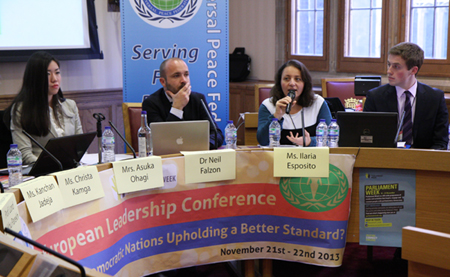 The final conference session of the ‘Human Rights: Are Democratic Nations Upholding a Better Standard?’ was organised by Youth UPF and entitled ‘Youth Human Rights and Education’. It was held in the House of Lords Committee Room 4A and hosted by Professor Lord Bhikhu Parekh on Friday November 22nd. This conference was partner of Parliament Week and was one of many events held during the week. Read the rest of this entry »
Posted in Peace and Development | Tagged: education, human rights, Peace and Development, Universal Peace Federation, UPF, vulnerable children | 1 Comment »
Posted by peacedevelopmentnetwork on November 24, 2013
 London UK – Justina Mutale, African Woman of the Year and Founder/CEO of POSITIVE RUNWAY: Global Catwalk to Stop the Spread is scheduled to address the European Leadership Conference at the Houses of Parliament and the House of Lords in London, on Thursday and Friday 21-22 November 2013.
The Conference is part of the activities of “PARLIAMENT WEEK” and part of a series of major events in National Parliaments including the United Nations in Geneva and Vienna, as well as the European Parliament in Brussels focused on issues of Human Rights, Human Development, the European Relationship with Africa and the Future of Multiculturalism.
– See more at: http://ukzambians.co.uk/home/2013/11/21/justina-mutale-to-address-the-european-leadership-conference/#sthash.d4YiV9rU.dpuf
Posted in Peace and Development | Tagged: Africa, equality, human rights, Universal Peace Federation, women's equality | Leave a Comment »
Posted by peacedevelopmentnetwork on November 22, 2013
11:15 5th Session – Youth Human Rights and Education – House of Lords Committee Room 4A
David Hayward: University of Glasgow: Young Persons and the Case Law Compilation of the European Convention on Human Rights and the European Social Charter
Dr Neil Falzon: Director of Human Rights, NGO Aditus Foundation
Ilaria Esposito: Advisory Council for Youth on the Council of Europe, ‘Rights for Youth in the Council of Europe’
Kanchan Jadeja: Chair at National Council for Voluntary Youth Services in UK
13:00 Return to 43 Lancaster Gate, London, W2 3NA
14:00 6th Session Over Closing Luncheon (& Ambassador for Peace Awards)
15.30 onwards – Departures
Posted in Peace and Development | Leave a Comment »
Posted by peacedevelopmentnetwork on November 22, 2013
Friday November 22nd – House of Lords Committee Room 4A
9:30 Session 4: The Human Rights of Immigrants and Refugees in Europe
Chair: Margaret Ali: Director Universal Peace Federation – UK
Prof. Lord Bhikhu Parekh: Professor of Political Philosophy, Univ. of Westminster
Mr. Ahmed Shebani: Founder of The Democratic Party in Libya, ‘Illegal Migration from North Africa to Europe’
Dr Neil Falzon: Director of Human Rights, NGO Aditus Foundation
Mr. Camel Bechikh: President and Founder, Fils de France
11:00 Break
11:30 5th Session – Youth Human Rights and Education – House of Lords Committee Room 4A
David Hayward: University of Glasgow: Young Persons and the Case Law Compilation of the European Convention on Human Rights and the European Social Charter
Dr Neil Falzon: Director of Human Rights, NGO Aditus Foundation: ‘Will Refugees and Migrants Always Remain Borderliners?’
Ilaria Esposito: Advisory Council for Youth on the Council of Europe, ‘Rights for Youth in the Council of Europe’
Kanchan Jadeja: Chair at National Council for Voluntary Youth Services in UK
13:00 Return to 43 Lancaster Gate, London, W2 3NA
14:00 6th Session Over Closing Luncheon (& Ambassador for Peace Awards)
15.30 onwards – Departures
Posted in Peace and Development | Leave a Comment »
Posted by peacedevelopmentnetwork on October 29, 2013
The ‘conflict minerals’ issue, one of the factors fueling the violence of the eastern Democratic Republic of Congo, has received attention in the US, the OECD and now the European Union. Robin Marsh commented on the ‘responsible sourcing of conflict minerals’ legislation that will be proposed by the European Union Trade Commission by the end of the year. It is an issue that was highlighted in a European Parliament event organised by UPF on June 26th. UPF will hold another
event on November 21st in Parliament to discuss ‘conflict mineral’ developments in the US legislation, proposed legislation in the EU and OECD guidelines for conflict minerals.
Some companies and mineral federations are making efforts to create protected supply lines that improve the income for miners and the level of state governance. Research results reported by several groups have highlighted problems and the scale of the current illicit trade.
Posted in Peace and Development | Tagged: Conflict Minerals, DRC, DRCongo, human rights, Poverty, Universal Peace Federation, UPF | Leave a Comment »
Posted by peacedevelopmentnetwork on September 25, 2013
 On UN International Peace Day, Universal Peace Federation – UK helped Tally Koren to organise a wonderful concert of Middle Eastern musicians in support of the Parents Circle Family Forum. ‘Music for Peace in the Middle East’ included Palestinian Oud player and singer, Nizar Al-Issa, guitarist Udi Glazer, Anna Kempton on Chello, violinist Julia Stone and Woody Dean on the piano and was held in the classic church background of St Peter’s in Notting Hill. Photos http://bit.ly/16zleFD
Music for Peace in the Middle East was a celebration of music from different cultures. Each person here tonight is supporting the language of love and on this note the first musician, the Persian Hamid Rasti, started playing with his instrument of 72 strings so beautifully. It was just music, peace, hearts beating and calming down in this church. It was just beautiful and every time we turned our heads back more people where coming in. Music has no barrier, as he diligently played and with what looked like chopsticks we all relaxed and he took us on a journey of hope.
Read the rest of this entry »
Posted in Cultural Programme, Peace and Development | Tagged: Concert, Middle East, Nizar Al-Issa, peace, Tally Koren, United Nations, Universal Peace Federation | 1 Comment »
Posted by peacedevelopmentnetwork on September 21, 2013

Israeli singer songwriter Tally Koren heads a cast of Israeli and Palestinian musicians in a recital, ‘An Evening of Music for Peace in the Middle East’ taking place on the International Day of Peace, Saturday, September 21 at St. Peters Church on Kensington Park Road W11. The event organized by the Universal Peace Federation UK is a fundraising occasion for the Parents Circle Families Forum, which helps bereaved Palestinians and Israelis to reconcile their differences as an alternative to conflict.
http://musicforpeaceinthemiddleeast.eventbrite.co.uk
Fundraising Event for The Parents Circle Families Forum
Bereaved Palestinians and Israelis who promote reconciliation as an alternative to conflict
Doors open 7.45 pm Show starts 8.15 pm
St Peter’s Church, Kensington Park Road, Notting Hill, London W11 2PN
Tally Koren, is a BBC Radio 2 playlist artist and the Fringe Award Winner For Best Singer-Songwriter. Her music was played by Chris Evans, Graham Norton, Janice Long and Steve Wright ,the Aled Jones’ Good Morning Sunday Show and was featured on the Virgin Media TV playlist and 100 other UK radio stations. She is passionate about this concert saying, “ I believe strongly that through culture we can bridge the gap for a better future “
Nizar Al-Issa is a singer with extraordinary range and control as well as a virtuoso on the oud (a cousin of the lute). He draws on traditional middle eastern music but is not afraid to upset the purists by mixing things up a little – a habit he puts down to his refugee background. Nizar explained, “ I am part of this concert for peace and humanity” His roots are in Ramallah but in his influences and attitudes he crosses borders. “Iraqis ask me if I’m from Iraq, while the Egyptians are convinced I am from Cairo, and in Spain they’re sure that I’ve spent time learning gypsy Flamenco… but the heart and soul of my music is the knowledge that we all share far more in common as human beings than we acknowledge, wherever we come from.”
Udi Glaser is a composer (film composer, composer for theatre, etc.), an accomplished guitarist, educated musician, producer, experienced guitar teacher and music theory tutor. Udi has dedicated his life to music.
Posted in Peace and Development | Tagged: human rights, Middle East, music for peace, one family under God, Universal Peace Federation, UPF | Leave a Comment »
Posted by peacedevelopmentnetwork on August 24, 2013
 Unification Peace Rally of 70 nations of the World for the realization of Unification of the Korean Peninsula and the DMZ World Peace Park. The event was held at 11:00 a.m. on August 24th, the day after the commemoration ceremony for the anniversary of Father Moon’s ascension.
About 1600 people, including 300 Korean residents in Japan, gathered at the Imjingak to pray for the peaceful reunification of South and North Korea. Doves were released expressing hope for the reunification of Korea and the establishment of the DMZ World Peace Park.
This followed a condolence message sent from Kim Jong-un, the Supreme leader of North Korea, to Dr. Hak Ja Han Moon, co-founder of the Universal Peace Federation and Family Federation for World Peace and Unification to mark the one-year anniversary of the passing of the Reverend Sun Myung Moon, according to North Korea’s chief news agency.
The Korean Central News Agency (KCNA), North Korea’s official wire service, quoted Kim Jong-un, “I pray for the repose of Rev. Sun Myung Moon, who worked for harmony and prosperity of the Korean people, the unification of Korea and world peace.” He added that he wishes that Dr. Hak Ja Han Moon and her family would inherit and carry forward Rev. Sun Myung Moon’s will and also sends his best wishes to their work.
Posted in Peace and Development | Tagged: conflictandpeaceresolution, Korea, one family under God, unification, UniversalPeaceFederation, UPF | Leave a Comment »
Posted by peacedevelopmentnetwork on August 23, 2013

Former Senator Jose de Venecia who addressed the Commemoration Ceremony of Father Moon’s First Ascension Anniversary in South Korea
FIRST ANNIVERSARY MEMORIAL PROGRAMME FOR THE REVEREND DR. SUN MYUNG MOON,
FOUNDER OF THE UNIVERSAL PEACE FEDERATION (UPF)
AUGUST 23, 2013, CHEONG PYEONG PEACE CENTER, REPUBLIC OF KOREA
Dear Dr. Hak Ja Han Moon and members of the Moon Family.
Excellencies. Ambassadors for Peace. Ladies and Gentlemen.
It is my distinct honor and privilege to have the opportunity to share with you a few words this morning in honor of the life, the teachings and the legacy of the Rev. Dr. Sun Myung Moon who passed away to the spiritual world one year ago today.
I am always moved and uplifted when I come to Cheong Pyeong. My wife, Congresswoman Gina de Venecia, and I have had the very good fortune to have visited Father and Mother Moon on many occasions in this holy place, this holy land.
In particular, Gina and I will never forget the kindness and compassion shown to us by Father and Mother Moon following the tragic accident that led to the untimely passing of our beloved daughter, KC (Kristina Casimira). Both of us were deeply moved by the love and care which both Father and Mother Moon provided at that difficult time. Indeed it was one of the most difficult times in our life, and we will never forget their generosity and loving kindness. (Report on Conference http://bit.ly/134D7ho)
Read the rest of this entry »
Posted in Peace and Development | Tagged: family, FatherMoon, Interfaith, PeaceAndConflictResolution, spirituality, United Nations, Universal Peace Federation, UPF | 2 Comments »
Posted by peacedevelopmentnetwork on August 16, 2013

Universal Peace Federation – UK Newsletter August 2013 Page 2
Posted in Peace and Development | Tagged: Community Cohesion, Conflict Minerals, Congo, DRC, human rights, Interfaith, Peace and Development, PeaceAndConflictResolution, Sexual Violence, Universal Peace Federation, UPF, Youth | Leave a Comment »




 Having trouble viewing the email below?


 PeaceDevelopmentNetwork's Weblog